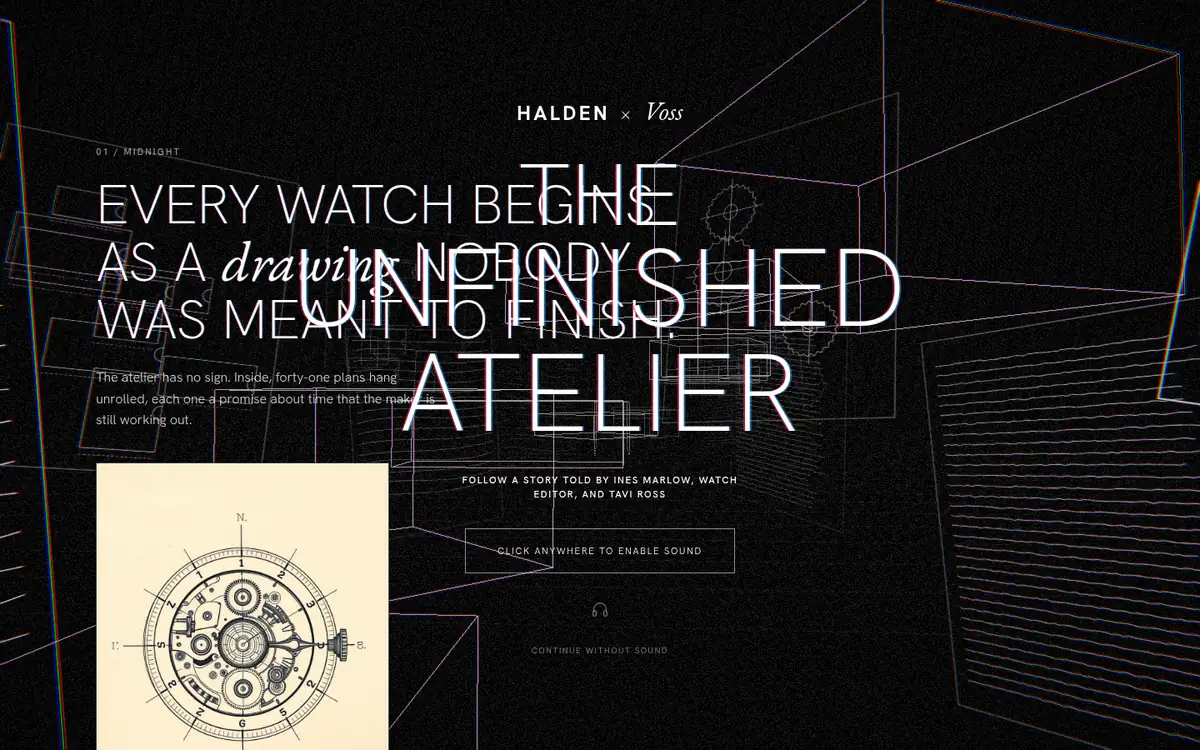
A sponsored editorial story that is not a page but a flight through a blueprint. The whole screen is one black WebGL space of white hairline drawings (floor plans, sketches, technical plates) floating in perspective. Scrolling moves a camera through it while short chapters of light, uppercase type appear over the drawing. A sound gate opens the experience.
Rebuild: design-inspiration-rebuilds/fashion/extraordinary-lab (fictional content, generated images, open-source fonts; installed with the optional design-inspiration-rebuilds skill). Run it with npm install && npm run dev.
Design Tokens
| Role | Value |
|---|---|
| Background | #000000 |
| Line / type | #ffffff, secondary rgba(255,255,255,.55) |
| Aberration fringes | red rgba(255,40,80,.5), blue rgba(40,160,255,.5) |
:root {
  --bg: #000; --ink: #fff; --dim: rgba(255,255,255,.55);
  --ease: cubic-bezier(.22, 1, .36, 1);          /* expo-like out, used for UI */
}
.gate h1 { font-weight: 200; text-transform: uppercase; line-height: .95;
  text-shadow: -2px 0 rgba(255,40,80,.55), 2px 0 rgba(40,160,255,.55); }   /* CSS echo of the RGB split */
- Type: a very light geometric grotesk (original: GT America thin; substitute Hanken Grotesk
- in uppercase for titles, 500-weight tiny tracked caps for UI labels, and one high-contrast garamond italic (EB Garamond) for single accent words and the partner mark.
- Palette: pure black and white only. Colour appears solely as the red/blue edge fringe of the lens effect.
- Shape: no cards, no radii, no shadows. 1px white frames around buttons and images.
Motion Spec
| What | Trigger | Animation | Duration / easing | Rebuild file |
|---|---|---|---|---|
| Smooth scroll | always | Lenis { lerp: .08 } on gsap.ticker, locked until the gate closes |
— | src/scroll.js |
| Camera flight | scroll 0 → 1 | camera rides a CatmullRom spline, looks 3% ahead on the same curve, damped .06 per frame, pointer parallax ±.35 |
continuous | src/scene.js |
| Blueprint world | always | 44 sketch plates + 26 edge-only boxes + ground grid, FogExp2 .028 fades distance to black |
— | src/scene.js |
| Procedural sketches | load | canvas hairlines (plans, gears, sections, scribble) used as plate textures | — | src/sketch.js |
| Chromatic aberration | always, scroll velocity | RGB split grows with radius and with scroll speed; grain and vignette in the same pass | split .0016 + vel * .02 |
src/post.js |
| Sound gate | click anywhere | gate fades, scroll unlocks, drone fades in | gate 1.2s, audio 2s | src/audio.js |
| Title intro | load | title lines rise and fade | 1.6s expo.out, stagger .15 |
src/main.js |
| Chapter text | enters at 75% | blur 6px → 0, y: 24 → 0, reverses on scroll up |
1.2s expo.out, stagger .12 |
src/chapters.js |
| Figure reveal | enters at 85% | clip-path: inset(0 0 100% 0) opens downward |
1.3s expo.out |
src/chapters.js |
Key excerpts
Camera on a spline: src/scene.js
const path = new THREE.CatmullRomCurve3([
  [0, 0, 6], [-1.5, 0.6, -20], [2.5, -0.4, -48], [-2, 1, -76], [1.5, -.2, -100], [0, 0, -124],
].map((p) => new THREE.Vector3(...p)));
// ...
state.cur += (state.target - state.cur) * 0.06;          // damped scroll progress
camera.position.copy(path.getPoint(Math.min(state.cur, .995)));
camera.position.x += state.mx * 0.7; camera.position.y -= state.my * 0.5;
camera.lookAt(path.getPoint(Math.min(state.cur + .03, 1)));
Scroll progress is a single number; the whole story is one curve.
Chromatic aberration pass: src/post.js
vec2 d = vUv - .5;
float k = uSplit * (.4 + dot(d,d) * 6.);          // split grows toward the edges
float r = texture2D(tDiffuse, vUv + d * k).r;
float g = texture2D(tDiffuse, vUv).g;
float b = texture2D(tDiffuse, vUv - d * k).b;
Velocity-driven split: src/scene.js
state.vel = Math.abs(state.cur - prev) * 60;
ca.uniforms.uSplit.value = 0.0016 + Math.min(state.vel * 0.02, 0.012);
Fast scrolling tears the colour channels apart, stopping heals them.
Chapter reveal: src/chapters.js
gsap.set(items, { opacity: 0, y: 24, filter: 'blur(6px)' });
gsap.to(items, { opacity: 1, y: 0, filter: 'blur(0px)', duration: 1.2, ease: 'expo.out', stagger: 0.12,
  scrollTrigger: { trigger: ch, start: 'top 75%', toggleActions: 'play none none reverse' } });
Sound gate: src/audio.js
const lp = ctx.createBiquadFilter(); lp.type = 'lowpass'; lp.frequency.value = 220;
[55, 55.7, 110.2].forEach((f, i) => { /* detuned sines into the lowpass */ });
lfo.frequency.value = .08;                       // slow breathing on master gain
gsap.to(master.gain, { value: on ? .35 : 0, duration: 2, ease: 'power2.out' });
prefers-reduced-motion: Lenis, damping and all reveals are off; the camera still follows scroll
but jumps directly to the target.
Why Award-Worthy
- The interface is the world. No page chrome competes with the scene; a single fixed canvas holds the identity and the text sits on top of it.
- Monochrome discipline. Only black and white line work, so the lens fringe is the sole colour and reads as light, not decoration.
- Scroll as camera. One progress value drives a spline flight, which makes pacing trivial to tune and feels like film rather than a page.
- Light, uppercase type with one serif accent. Thin weights echo the hairline drawings.
- Sound as a gate. A single deliberate click starts audio and scroll together, which sets the tone before any content appears.
Anti-patterns it avoids: no cards or boxes of copy, no colour gradients, no parallax sections stacked on a normal page, no autoplaying audio without consent.
Credits
- Original: GQ & AP The Extraordinary Lab by Immersive Garden. Design and content are the intellectual property of their creators.
- Recognition: Awwwards Site of the Month (Mar 2026), Site of the Day, Developer Award.
- This study is an independent clean-room analysis. The rebuild uses a fictional brand and story, procedural drawings, AI-generated images and open-source fonts; it contains no original code, assets or copy.