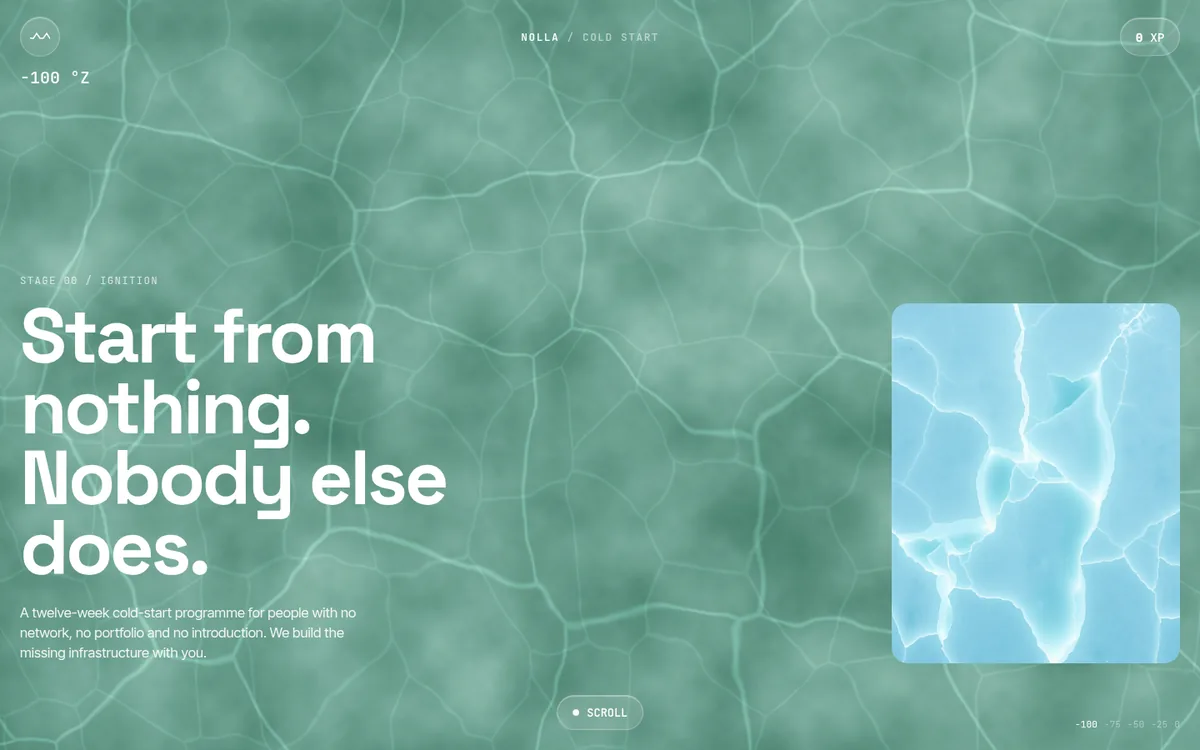
A single-viewport, game-like admissions site for a school that promises "human infrastructure to get hired". The page never scrolls: wheel or swipe moves you through temperature stages (-100 to 0) while a full-screen WebGL surface of cracked, frosted green ice thaws into calm water. The interface is a HUD (audio, XP, stage readout) rather than a website, and the main input is a gesture: draw a zero with the pointer.
Rebuild: design-inspiration-rebuilds/culture-education/why-zero (fictional content, generated images, open-source fonts; installed with the optional design-inspiration-rebuilds skill). Run it with npm install && npm run dev.
Design Tokens
| Role | Value |
|---|---|
| Deep teal (loader, panels) | #17463d |
| Ice teal (page base) | #2f8f76 |
| Mint highlight (thawed water, cracks) | #c6efe1 |
| Ink | #ffffff, secondary at 50-70% alpha |
:root { --teal:#2f8f76; --deep:#17463d; --mint:#c6efe1; --ease:cubic-bezier(.16,1,.3,1); }
.glass { background: rgba(255,255,255,.12); backdrop-filter: blur(14px) saturate(1.4);
  border: 1px solid rgba(255,255,255,.28); box-shadow: inset 0 1px 0 rgba(255,255,255,.35); border-radius: 100px; }
- Type: a chunky square-ish grotesk for display and the loader digits (original: Supply Sans family; substitute: Space Grotesk 700), a mono for every label and HUD value (JetBrains Mono), a neutral sans for body copy (Inter Tight). Loader digits are 100px, display up to ~6.4rem at line-height .92 and -.04em tracking.
- Colour: one hue (green-teal) in three values. The whole palette is the gradient of the shader; UI is white on top of it.
- Chrome: pill-shaped frosted-glass chips for audio, XP and the scroll hint. Layers in the original (fill, highlight, edge-light, inner-glow) are collapsed into one translucent fill plus an inset top highlight.
Motion Spec
| What | Trigger | Animation | Duration / easing | Rebuild file |
|---|---|---|---|---|
| Odometer preloader | load | two 0-9 digit stacks roll 00 to 99, then the overlay slides up | 2.2s power2.inOut; exit 1s expo.inOut |
src/loader.js |
| Ice surface | always | voronoi cracks warped by fbm, noisy frost line, vertical thawed gradient | continuous | src/ice.js |
| Thaw with progress | stage progress | uTemp 0 to 1 moves the frost line from full coverage to none |
follows eased stage value | src/ice.js |
| Stage track | wheel / swipe / keys | target moves by deltaY * .0016, eased value follows, snaps to integer after 180ms idle |
lerp .08 per 60fps frame | src/stages.js |
| Stage panel transition | stage change | outgoing/incoming panels fade, drift 60px, blur up to 8px | follows the eased value | src/stages.js |
| Draw a zero | pointer drag | trail painted to a 256px canvas texture, fades 6% per frame, brightens the ice | per frame | src/draw.js |
| Zero recognised | pointer up | winding >= 300 degrees and loop closed: +50 XP, shader flash, "0" pop | 1s power3.out, shader burst decays x .94 per frame |
src/main.js |
| Next-stage ring | progress | SVG ring dash offset shows progress to the next stage | scrubbed | src/main.js |
| Audio chip | always | polyline waveform oscillates | continuous | src/main.js |
Key excerpts
Frost line that thaws with progress: src/ice.js
float frostLine=-.15+1.3*uTemp+(fbm(p*4.)-.5)*.35;   // noisy edge
float frost=smoothstep(frostLine-.04,frostLine+.04,uv.y);
vec3 water=mix(deep,mint,pow(1.-uv.y,2.2)*.9);
vec3 ice=mix(deep*.85,mint,mottled*.55+.1)+crack*vec3(.75,1.,.9)*(.28+uBurst);
vec3 col=mix(water,ice,frost);
Cracks from voronoi edge distance: src/ice.js
vec2 w=p*5.+vec2(fbm(p*2.+uTime*.03),fbm(p*2.+7.))*.9 + t*.25;   // t = cursor trail
vec2 v=vor(w);                                   // v.x = distance to nearest cell edge
float crack=1.-smoothstep(0.,.07+t*.05,v.x);     // trail widens the cracks
Page that never scrolls: src/stages.js
addEventListener('wheel', (e) => bump(e.deltaY * 0.0016), { passive: true });
// ...
cur += (target - cur) * (1 - Math.pow(0.92, dt * 60));   // frame-rate independent lerp
panels.forEach((p, i) => {
  const d = Math.min(1, Math.abs(cur - i)), s = Math.sign(i - cur);
  p.style.opacity = 1 - d;
  p.style.transform = `translateY(${s * d * 60}px)`;
  p.style.filter = d > 0.01 ? `blur(${d * 8}px)` : 'none';
});
Zero detection: src/draw.js
// winding angle around the centroid, summed over the path
let d = a - a0;
if (d > Math.PI) d -= 2 * Math.PI; if (d < -Math.PI) d += 2 * Math.PI;
wind += d;
// ...
return Math.abs(wind) > (300 * Math.PI) / 180 && end < diag * 0.22 && diag > 30;
Odometer preloader: src/loader.js
gsap.timeline({ onComplete: () => { el.remove(); done(); } })
  .to(o, { v: 99, duration: 2.2, ease: 'power2.inOut', onUpdate() {
    const n = Math.round(o.v);
    gsap.set(ins[0], { yPercent: -Math.floor(n / 10) * 10 });   // tens
    gsap.set(ins[1], { yPercent: -(n % 10) * 10 });             // ones
  } })
  .to(el, { yPercent: -100, duration: 1, ease: 'expo.inOut' }, '+=.25');
prefers-reduced-motion: the preloader is skipped and the shader and waveform are static; stage
changes still work from wheel, swipe and arrow keys.
Why Award-Worthy
- The site is an object, not a page. One viewport, a HUD and a progress readout turn admissions into a small game. Scroll becomes a physical quantity (temperature), not a document.
- One shader, one story. The ice thawing as you progress is the entire narrative: the surface state is the progress bar, so no separate chrome is needed.
- Input as brand. Drawing a zero is the name of the school, performed by the visitor, and it feeds XP, the shader and the UI at once.
- Restraint in colour and copy. A single green-teal hue and very short copy per stage keep a heavy WebGL surface legible.
- Polish in the in-betweens. The odometer loader, glass chips and eased, snapping stage motion make small states feel designed.
Anti-patterns it avoids: no long scrolling page with sections; no stock photography behind the hero; no menu bar of links; the WebGL layer never blocks the controls.
Credits
- Original: why.zero.university by Sindhur Dutta. Design and content are the intellectual property of their creators.
- Recognition: Awwwards Site of the Month (Sep 2026), Site of the Day, Developer Award.
- This study is an independent clean-room analysis. The rebuild uses a fictional institute, AI-generated images and open-source fonts; it contains no original code, assets or copy.