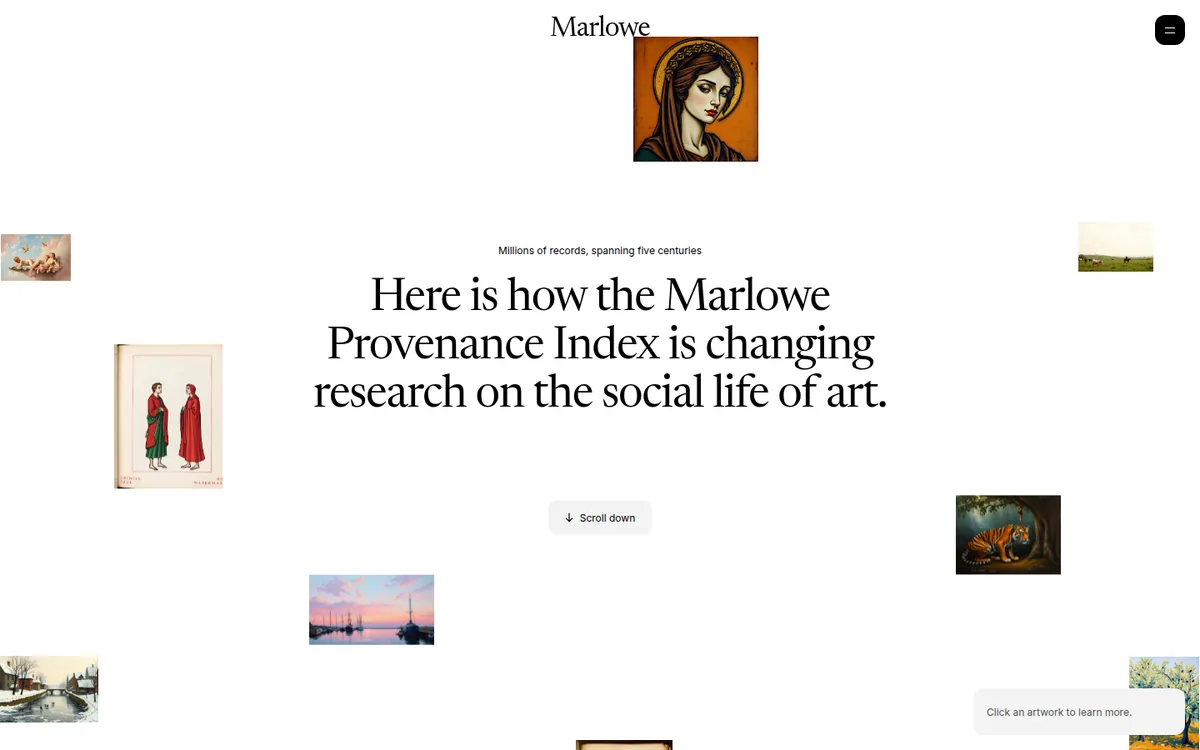
An editorial scroll story about the ownership history of artworks. There is almost no chrome: a white page, one pale blue-grey chapter colour, a refined serif for every sentence and the artworks themselves as the only colour. The page moves from a scatter of floating cards, to a pinned chain of owners around one painting, to a rotating WebGL sphere that shows the scale of the data.
Rebuild: design-inspiration-rebuilds/culture-education/tracing-art (fictional content, generated images, open-source fonts; installed with the optional design-inspiration-rebuilds skill). Run it with npm install && npm run dev.
Design Tokens
| Role | Value |
|---|---|
| Page | #ffffff |
| Ink | #000000 |
| Chapter background (pale blue-grey) | #dbe2e9 |
| Chip / card placeholder | #f3f3f3 |
| Muted caption | #8a8f94 |
:root {
  --bg: #fff; --chapter: #dbe2e9; --ink: #000; --chip: #f3f3f3; --mute: #8a8f94;
  --serif: 'Instrument Serif', Georgia, serif;   /* original: a bookish serif (Bardford) */
  --sans: Inter, Roboto, 'Helvetica Neue', sans-serif; /* original: Graphik */
  --ease: cubic-bezier(.65, .05, 0, 1);
}
- Type: serif at 64px / line-height 1 /
letter-spacing: -.03emfor the intro headline; 34px for the mid-page statement; 56px for owner names. The sans is tiny (11-12px) and used only for eyebrows, captions and buttons, so serif versus sans reads as voice versus label. - Shape: 10-12px radii on pills and the menu button, a solid black menu button with two hairlines,
grey
#f3f3f3chips. No shadows, no borders. - Layout: copy is centred or pinned to the 72px left margin; artworks are never framed or captioned decoratively, only with title (underlined), maker and an 10px grey source line.
- Progress: a vertical pill with dots; the active dot stretches to a 14px bar.
Motion Spec
| What | Trigger | Animation | Duration / easing | Rebuild file |
|---|---|---|---|---|
| Smooth scroll | always | Lenis { lerp: .1 } driven by gsap.ticker, lagSmoothing(0) |
— | src/scroll.js |
| Floating artwork cards | scroll | each card drifts on its own scrubbed y offset (depth 0.8-1.5) | scrubbed | src/cards.js |
| Cursor parallax | pointer | image inside each card follows the cursor, amplitude = depth * 28px | 1.2s power3.out (quickTo) |
src/cards.js |
| Card entrance | enters at 80% | scale .6 → 1 + opacity | 1.2s power3.out, stagger .06 |
src/cards.js |
| Click an artwork | click | caption of the work appears in the bottom-right chip | instant | src/cards.js |
| Owner chapters | pinned 400vh | progress crosses i/N: owner names rise from a mask, artwork opens with inset clip-path, image scale 1.3 → 1, background tints |
names 1s power3.out; frame 1.1s power3.inOut; bg 1.2s power2.inOut |
src/chapters.js |
| Progress dots | scroll | only visible while the chapter section is active | .4s | src/chapters.js |
| Data sphere | scroll | 150 image planes assemble from scatter to a Fibonacci sphere over the first 35% of the section, then rotate one full turn; cursor tilts the group | scrubbed with lerp .08 | src/sphere.js |
| Menu | click | black panel opens with a circle clip-path from the button; links pop in |
.8s power3.out; links back.out(1.2) |
src/menu.js |
| Hero entrance | load | copy rises 40px and fades in | 1.2s power3.out, stagger .1 |
src/main.js |
Key excerpts
Smooth scroll on the GSAP ticker: src/scroll.js
lenis = new Lenis({ lerp: 0.1, smoothWheel: true, autoRaf: false });
lenis.on('scroll', ScrollTrigger.update);
// ...
gsap.ticker.lagSmoothing(0);
gsap.ticker.add((t) => {
  if (lenis) lenis.raf(t * 1000);
  frame.forEach((fn) => fn(t));     // WebGL renders in the same tick
});
Pinned owner chapters: src/chapters.js
ScrollTrigger.create({
  trigger: stage, start: 'top top', end: `+=${chapters.length * 100}%`, pin: true,
  onUpdate: (s) => show(Math.min(chapters.length - 1, Math.floor(s.progress * chapters.length))),
});
// ...
gsap.fromTo([lIn, rIn], { yPercent: 110 }, { yPercent: 0, duration: 1, ease: 'power3.out', stagger: 0.12 });
gsap.fromTo(frame, { clipPath: 'inset(100% 0% 0% 0%)' },
  { clipPath: 'inset(0% 0% 0% 0%)', duration: 1.1, ease: 'power3.inOut' });
gsap.to(stage, { backgroundColor: c.tint, duration: 1.2, ease: 'power2.inOut' });
Scroll only selects the beat; the beat itself plays as a normal timed animation, so it never looks scrubbed or jittery.
Floating cards with depth: src/cards.js
gsap.to(el, { y: (d - 1) * 260 - 40, ease: 'none',
  scrollTrigger: { trigger: host, start: 'top bottom', end: 'bottom top', scrub: true } });
const qx = gsap.quickTo(el.firstChild, 'x', { duration: 1.2, ease: 'power3.out' });
// ...
qx(-nx * d * 28);     // nx = cursor x in -0.5..0.5, d = card depth
Image sphere with billboards: src/sphere.js
const y = 1 - (i / (N - 1)) * 2, r = Math.sqrt(1 - y * y), th = i * 2.399963;   // Fibonacci sphere
// ...
inv.copy(group.quaternion).invert().multiply(cam.quaternion);   // planes always face the camera
m.position.lerpVectors(from, to, e);                            // e = eased assembly 0..1
m.material.opacity = (0.15 + 0.85 * THREE.MathUtils.smoothstep(wp.z, -2.3, 2.3)) * Math.min(1, e * 1.5);
Depth-based opacity keeps the back of the sphere as a ghost so the front images stay readable.
Menu circle from the button: src/menu.js
const at = 'at calc(100% - 36px) 36px';        // centre of the menu button
gsap.to(menu, { clipPath: `circle(150% ${at})`, duration: 0.8, ease: 'power3.out' });
gsap.fromTo(links, { yPercent: 110, rotate: 4 },
  { yPercent: 0, rotate: 0, duration: 0.9, ease: 'back.out(1.2)', stagger: 0.07, delay: 0.25 });
prefers-reduced-motion: Lenis, entrances, clip-path reveals and the sphere's drift are disabled;
chapters still switch on scroll and content is simply visible.
Why Award-Worthy
- The artworks are the interface. No cards-with-shadows or UI frames: paintings float on white, so the cultural content, not the chrome, carries the page.
- A narrative, not a gallery. Scatter → one painting's chain of owners → the whole network. Each scale change (one work, then thousands) is a different layout, so the story is felt through scroll.
- Restraint in colour and type. White, one blue-grey, black; a single serif for every statement and a tiny sans for labels.
- Data as a physical object. The sphere of thumbnails turns an abstract dataset into something you can orbit with the cursor, and it assembles from the scatter you just scrolled through.
- Click-to-learn, scroll-to-read. Both interaction modes are always available and neither blocks the other.
Anti-patterns it avoids: no drop shadows, gradients or glass; no decorative frames; no carousel; the WebGL layer is only used where it explains something (scale), not as a background.
Credits
- Original: getty.edu/tracingart by Resn. Design and content are the intellectual property of their creators.
- Recognition: Awwwards Site of the Month (Jul 2025), Site of the Day, Developer Award.
- This study is an independent clean-room analysis. The rebuild uses a fictional archive, fictional works and owners, AI-generated images and open-source fonts; it contains no original code, assets or copy.