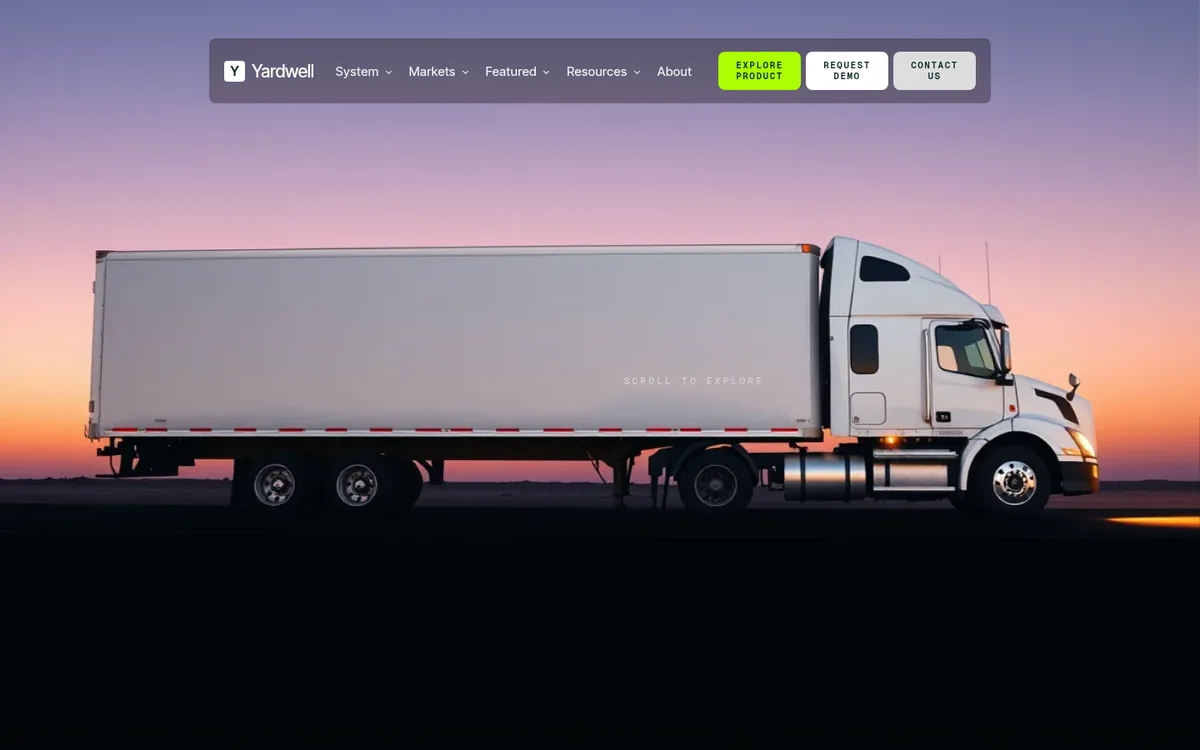
A B2B yard-logistics product site that behaves like a film. The hero is one long pinned scroll: a silhouetted truck at dusk, a camera cut into the yard where a particle scan dissolves the truck into data, then a black blueprint grid with the mission statement. After that the page turns calm and corporate: deep green ink, light grey cards and one acid lime used only for action and "AI" moments.
Rebuild: design-inspiration-rebuilds/business-corporate/terminal-industries (fictional content, generated images, open-source fonts; installed with the optional design-inspiration-rebuilds skill). Run it with npm install && npm run dev.
Design Tokens
| Role | Value |
|---|---|
| Deep green (text, footer, dark UI) | #052424 |
| Lime (primary button, chip text, hover glow) | #abff02 |
| Card grey | #f0f0f0 |
| Hairline | #dcdcdc |
| Muted mono label | #7f7f7f |
| Hero black | #000 with 93px white 10% grid |
:root {
  --ink: #052424; --lime: #abff02; --grey: #f0f0f0; --line: #dcdcdc; --mute: #7f7f7f;
  --sans: 'Inter Tight', system-ui, sans-serif;   /* original: Suisse Int'l */
  --mono: 'Geist Mono', ui-monospace, monospace;
}
- Type: a neutral Swiss grotesk at weight 400 only. Section H2
70px / 70px,letter-spacing: -3.6px(about -.05em): very tight, never bold. Hero statement73px / 69.7px,-1.47px. Card titles20px, body18px. - Mono labels: all UI furniture (buttons, eyebrows like "01 Fast start", footer headings) is
mono uppercase with wide tracking:
11px 600 +1.5pxon buttons,13px +2.3pxon eyebrows. The grotesk-plus-mono pair is what makes it read as software. - Shape: 8px radius on buttons, 32px on cards, 16px on the dark feature panel (with a notched left edge). No shadows; depth is blur (nav) and colour.
- Nav: a 938px blurred pill, fixed at
top: 46px, with three differently coloured CTAs (lime / white / grey) always visible.
Motion Spec
| What | Trigger | Animation | Duration / easing | Rebuild file |
|---|---|---|---|---|
| Smooth scroll | always | Lenis { lerp: .1 } on the GSAP ticker, lagSmoothing(0) |
— | src/scroll.js |
| Hero timeline | scroll, pinned 400vh | truck plate scales 1 → 1.12, yard wipes in from the right with clip-path, black grid fades in, statement words light up one by one |
scrub .6, wipe power2.inOut |
src/hero.js |
| Particle scan | hero scroll .2 → .6 | ~2600 points start on the truck, a sweep front reveals them left to right, then they scatter into the yard and fade | scrubbed uniform | src/particles.js |
| Headline reveal | enters at 85% | SplitText lines, inner span yPercent 105 → 0 inside an overflow-hidden line |
1.1s power4.out, stagger .08 |
src/reveals.js |
| Card entrance | enters at 88% | y 60 → 0, opacity, batched per row |
1s power3.out, stagger .12 |
src/reveals.js |
| Feature steps | scroll, pinned 300vh | progress picks the active step; text swaps, panel crossfades, HUD chip text changes, lime progress bar | text .6s power3.out, image .8s |
src/features.js |
| Logo grid | hover | lime radial glow follows the pointer inside the cell, 1px lime outline | .4s opacity | src/logos.js |
| Calculator | input | result number tweens to the new value | .8s power2.out |
src/calc.js |
| Nav tint | scroll past hero | blur pill gets a darker tint over white sections | CSS .4s | src/nav.js |
| Buttons | hover | lift 2px; pills invert to ink with lime text | .3-.4s | src/style.css |
Key excerpts
Hero: one scrubbed timeline, pinned: src/hero.js
const tl = gsap.timeline({
  defaults: { ease: 'none' },
  scrollTrigger: { trigger: hero, start: 'top top', end: '+=400%', pin: '.hero__stage', scrub: 0.6 },
});
tl.to('.hero__img--a img', { scale: 1.12 }, 0)
  .to('[data-yard]', { clipPath: 'inset(0 0 0 0%)', duration: 0.25, ease: 'power2.inOut' }, 0)
  .fromTo('[data-yard] img', { scale: 1.18 }, { scale: 1, duration: 0.6 }, 0)
  .to(state, { p: 1, duration: 0.4, onUpdate: () => (dots.progress = state.p) }, 0.2)
  .to(dark, { opacity: 1, duration: 0.2 }, 0.55)
  .to(split.words, { opacity: 1, stagger: 0.025, duration: 0.1 }, 0.7);
The timeline is 1 unit long, so the position parameters read as fractions of the scroll.
Particle scan shader: src/particles.js
float sweep = uP * 1.25 - 0.15;
float on = smoothstep(sweep + .08, sweep - .02, p.x);     // dots behind the front appear
float spread = smoothstep(.15, 1., uP);                    // then scatter outward
p.xy += seed.xy * spread * vec2(.34, .3) * (.4 + seed.z);
p.y += sin(uT * .8 + seed.z * 6.28) * .004;                // idle drift
vA = on * (1. - smoothstep(.85, 1., uP)) * (.35 + .65 * seed.z);
A 0..1 screen-space ortho camera, one Points draw call, one uniform driven by the timeline.
Smooth scroll + one frame loop: src/scroll.js
lenis = new Lenis({ lerp: 0.1, smoothWheel: true, syncTouch: false, autoRaf: false });
lenis.on('scroll', ScrollTrigger.update);
// ...
gsap.ticker.add((t) => { if (lenis) lenis.raf(t * 1000); frame.forEach((fn) => fn(t)); });
Headline line reveal: src/reveals.js
SplitText.create(el, {
  type: 'lines', linesClass: 'line', autoSplit: true,
  onSplit(self) {
    self.lines.forEach((l) => { l.innerHTML = `<span>${l.innerHTML}</span>`; });
    return gsap.fromTo(self.lines.map((l) => l.firstChild), { yPercent: 105 },
      { yPercent: 0, duration: 1.1, ease: 'power4.out', stagger: 0.08,
        scrollTrigger: { trigger: el, start: 'top 85%', once: true } });
  },
});
autoSplit re-splits on resize and the returned tween is reverted and rebuilt safely.
Pinned step sequence: src/features.js
ScrollTrigger.create({
  trigger: root, start: 'top top', end: '+=300%', pin: '.feat__pin', scrub: 0.5,
  onUpdate: (self) => {
    show(Math.min(2, Math.floor(self.progress * 3)));
    gsap.set(bar, { scaleX: self.progress });
  },
});
Scroll progress only chooses an index; each step animates itself, so fast scrolling never leaves half-faded text.
prefers-reduced-motion: smooth scroll, pins, the particle layer and reveals are off; the black
statement frame is shown as a static block and feature steps stack as normal content.
Why Award-Worthy
- A product demo disguised as a hero. The scroll itself explains the product: truck, yard, scan, data. One pinned timeline, one idea, no separate "how it works" section needed.
- Restraint after the spectacle. Once the film ends the page is plain grey cards and hairlines. The contrast makes the opening feel bigger and keeps the sales content readable.
- Mono as the product voice. Every label, button and HUD chip is mono caps; headlines stay in a quiet grotesk. The system feels technical without any illustration.
- One accent, rationed. Lime appears only on primary actions, the AI chip and the hover state, so it always means "act here" or "the system is working".
- Hairline grid as brand device. The logo wall, the hero blueprint and the footer line art share the same thin-line language, tying marketing to the product UI.
Anti-patterns it avoids: no stock-photo carousel, no gradient blobs, no bold type for emphasis, no scroll-jacking that blocks reading (the pins end in under four screens), no heavy shadows.
Credits
- Original: terminal-industries.com by REJOUICE. Design and content are the intellectual property of their creators.
- Recognition: Awwwards Site of the Month (Sep 2025), Site of the Day, Developer Award.
- This study is an independent clean-room analysis. The rebuild uses a fictional company, AI-generated images and open-source fonts; it contains no original code, assets or copy.