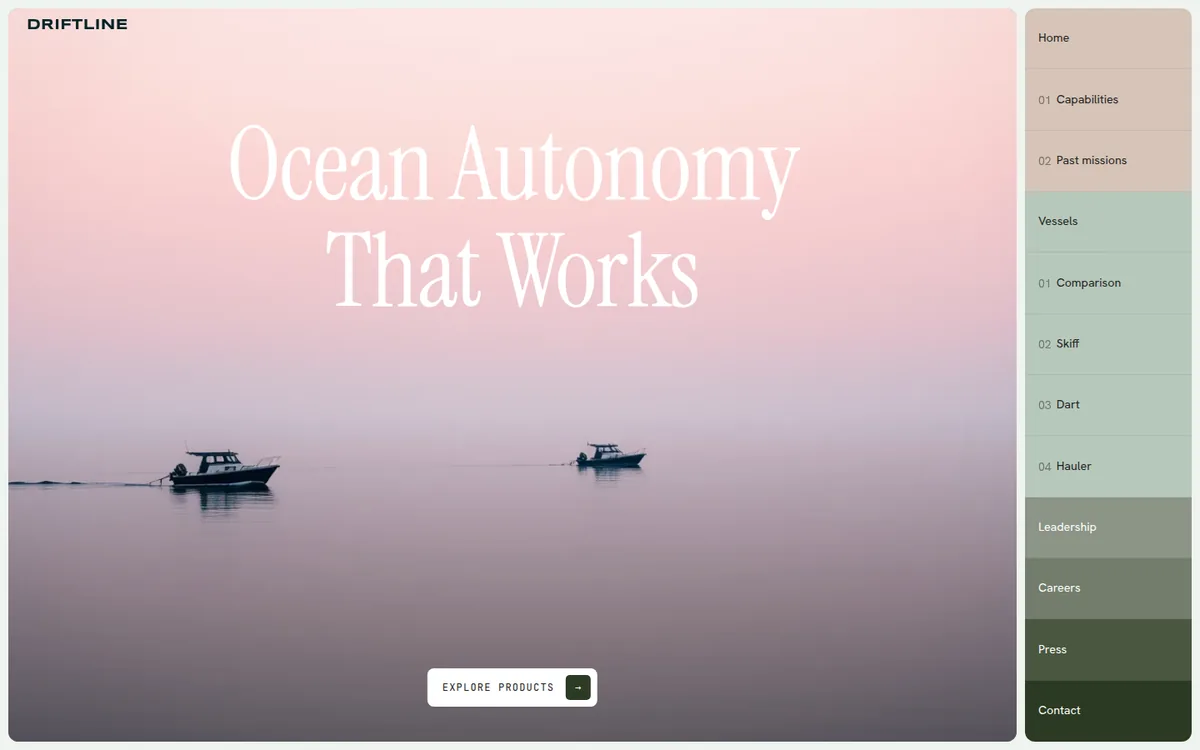
A defence-tech site for small uncrewed ocean vessels that behaves like a calm editorial film. A hero photograph sits in a rounded frame next to a stack of tinted menu rows; below it, three pinned stages (a rolling list of threats, a Deploy / Detect / React story, a vessel switcher) turn product copy into scroll-driven scenes. Light serif display type, a mono for labels, and a pale-mint to peach gradient keep a hard subject soft.
Rebuild: design-inspiration-rebuilds/institutions/seasats (fictional content, generated images, open-source fonts; installed with the optional design-inspiration-rebuilds skill). Run it with npm install && npm run dev.
Design Tokens
| Role | Value |
|---|---|
| Ink | #232323 |
| Page (pale mint) | #eef4ef |
| Menu row ramp | #d6c4b8 peach → #b7c8bb sage → #8c9487 → #737d6c → #4a5740 → #2c3a24 |
| Product gradient end stops | #fdebd0 peach, #e2ffd2 mint |
| Frame radius | 12px, 10px gutter around the hero |
:root {
  --ease: cubic-bezier(.65, .05, 0, 1);   /* hover and UI transitions, .75s */
  --serif: 'Instrument Serif', serif;      /* original: a light high-contrast serif */
  --mono: 'JetBrains Mono', monospace;     /* labels, buttons, tabs, uppercase */
}
h1 { font: 400 100.8px/.9 var(--serif); letter-spacing: -1px; }   /* original measured 100.8 / 90.7 */
body { font: 400 14.2px/1.4 var(--sans); }
- Type: three voices. Big light serif for statements, a quiet grotesk for body (14.2px) and a wide pixel-ish display face for the wordmark. Mono caps (12px, tracked) for every button, tab and image caption.
- Menu: not a hamburger overlay but a column of twelve full-height rows whose background walks from peach through sage to dark moss, so the colour itself becomes the wayfinding.
- Product light: vessel cutouts sit on a vertical gradient (mint → peach → lime-mint);
mix-blend-mode: multiplydrops the studio backdrop.
Motion Spec
| What | Trigger | Animation | Duration / easing | Rebuild file |
|---|---|---|---|---|
| Smooth scroll | always | Lenis { lerp: .1, smoothWheel, syncTouch } on the gsap ticker, lagSmoothing(0) |
— | src/scroll.js |
| Hero headline | load | each line rises out of an overflow mask, yPercent 110 → 0 |
1.2s power3.out, stagger .12 |
src/hero.js |
| Hero photo drift | scroll | image yPercent 0 → 12 while hero leaves |
scrubbed | src/hero.js |
| Menu stack | scroll past 40% of hero | stack slides out xPercent 110; MENU button fades in and recalls it |
.8s power3.out |
src/hero.js |
| Threat list | pinned, scrubbed | six lines; one is lit at a time, its image card wipes in from the bottom with clip-path |
.5s power2.out in, .3s out |
src/intel.js |
| Deploy / Detect / React | pinned, scrubbed | background photo crossfades, headline rises, four-column feature row staggers up | .7s power3.out, stagger .1 |
src/steps.js |
| Vessel switcher | scroll stops or tab click | outgoing vessel slides -12% and rotates -4°, incoming enters from +12%; spec text swaps |
.9s power3.out |
src/fleet.js |
| Floating thumbs | scroll | video-still cards drift ±40% in opposite directions |
scrubbed | src/fleet.js |
| Word reveal | enters at 85% | words in overflow masks, yPercent 110 → 0 |
1s power3.out, stagger .06 |
src/reveals.js |
| Mission cards | enters at 85% | clip-path inset(100% 0 0 0) → 0 plus inner image scale 1.2 → 1 |
1s power2.inOut / 1.4s power2.out |
src/reveals.js |
| Hover states | hover | link padding and brightness, CTA arrow nudge | .75s cubic-bezier(.65,.05,0,1) |
src/style.css |
Key excerpts
Smooth scroll on the GSAP ticker: src/scroll.js
lenis = new Lenis({ lerp: 0.1, smoothWheel: true, syncTouch: true, autoRaf: false });
lenis.on('scroll', ScrollTrigger.update);
gsap.ticker.add((t) => lenis.raf(t * 1000));   // gsap time is seconds, lenis wants ms
gsap.ticker.lagSmoothing(0);
Threat list: one pin, one timeline: src/intel.js
const tl = gsap.timeline({ scrollTrigger: { trigger: '.intel', start: 'top top',
  end: 'bottom bottom', scrub: 0.6, pin: '.intel-pin', anticipatePin: 1 } });
tl.fromTo('.intel-bg', { scale: 1.15 }, { scale: 1, duration: lis.length, ease: 'none' }, 0);
lis.forEach((li, i) => {
  tl.call(() => lis.forEach((o, j) => o.classList.toggle('on', j === i)), null, i + 0.05);
  tl.fromTo(cards[i], { opacity: 1, clipPath: 'inset(100% 0 0 0)' },
    { clipPath: 'inset(0% 0 0 0)', duration: 0.5, ease: 'power2.out' }, i + 0.05);
  tl.to(cards[i], { opacity: 0, duration: 0.3, ease: 'power2.in' }, i + 0.9);
});
One timeline unit per line, so the list is just lis.length units of scroll.
Three acts in one pinned stage: src/steps.js
heads.forEach((h, i) => {
  const t = i * 3;
  if (i) tl.to(bg[i], { opacity: 1, duration: 0.8, ease: 'none' }, t - 0.4);   // photo crossfade
  tl.fromTo(h, { yPercent: 60, opacity: 0 }, { yPercent: 0, opacity: 1, duration: 0.7, ease: 'power3.out' }, t);
  tl.fromTo(cols[i].children, { y: 30, opacity: 0 },
    { y: 0, opacity: 1, duration: 0.6, ease: 'power2.out', stagger: 0.1 }, t + 0.2);
  if (i < heads.length - 1) tl.to([h, cols[i]], { opacity: 0, duration: 0.5, ease: 'power2.in' }, t + 2.4);
});
Scroll stops drive a tabbed product: src/fleet.js
const go = (i) => {
  const dir = i > cur ? 1 : -1;
  gsap.to(vs[cur], { opacity: 0, xPercent: -12 * dir, rotate: -4 * dir, duration: 0.9, ease: 'power3.out' });
  gsap.fromTo(vs[i], { opacity: 0, xPercent: 12 * dir, rotate: 4 * dir },
    { opacity: 1, xPercent: 0, rotate: 0, duration: 0.9, ease: 'power3.out' });
  // ...
  cur = i;
};
ScrollTrigger.create({ trigger: root, start: 'top top', end: 'bottom bottom', pin: '.fleet-pin',
  onUpdate: (s) => go(Math.min(2, Math.floor(s.progress * 3))) });
Tabs call lenis.scrollTo to the stop's scroll position, so scroll and click share one state path.
Mask reveal for words: src/reveals.js
el.innerHTML = el.textContent.split(/\s+/).map((w) => `<span class="w"><span>${w}</span></span>`).join(' ');
gsap.from(el.querySelectorAll('.w > span'), { yPercent: 110, duration: 1, ease: 'power3.out',
  stagger: 0.06, scrollTrigger: { trigger: el, start: 'top 85%', once: true } });
prefers-reduced-motion: smooth scroll and all pinning are off, the tracks collapse to normal
height and every list, card and column is simply visible.
Why Award-Worthy
- Story as pinned stages. Each pinned stage carries one idea (what we find, how it works, what we sell) so a technical product reads as three scenes rather than a spec sheet.
- Colour as navigation. The tinted menu stack ties the hero, menu and footer into one palette and replaces an overlay with something that is always legible.
- Soft palette for a hard subject. Pale mint, peach and moss plus a light serif make defence hardware feel calm and credible.
- Product on a gradient. Vessels are shown large, uncropped and lit by the page itself, with floating footage stills that keep the stage alive without video chrome.
- Restraint in motion. Two easings (
power3.out,power2.out), one reveal shape per element type, no scroll-jacking beyond the pins.
Anti-patterns it avoids: no hamburger-only navigation on desktop, no carousel arrows (scroll and tabs share state), no stock-gradient hero, no autoplay clutter over the copy.
Credits
- Original: seasats.com by Raw Materials. Design and content are the intellectual property of their creators.
- Recognition: Awwwards Site of the Day, Developer Award.
- This study is an independent clean-room analysis. The rebuild uses a fictional company, AI-generated images and open-source fonts; it contains no original code, assets or copy.