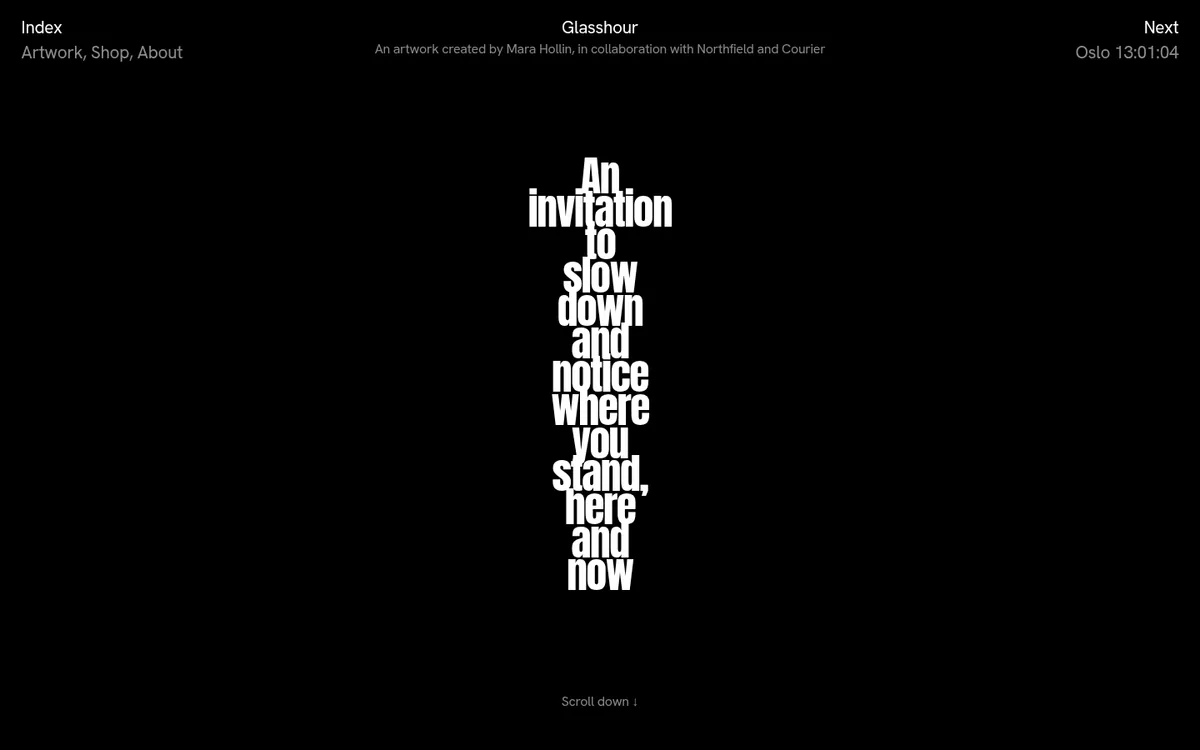
A companion site for a public light artwork, built as one long black-and-white editorial scroll. The signature is type pulled to the edges: a condensed capital wordmark is stretched to fill the whole viewport, letters arrive sliced and displaced and settle as you scroll, and giant partner names span the page width. Everything else is quiet: pure black and white, one condensed display face, one small grotesk, a live clock and countdown.
Rebuild: design-inspiration-rebuilds/institutions/lifeworld (fictional content, generated images, open-source fonts; installed with the optional design-inspiration-rebuilds skill). Run it with npm install && npm run dev.
Design Tokens
| Role | Value |
|---|---|
| Light (page, light sections) | #fff |
| Dark (page, dark sections, ink) | #000 |
| Muted text on dark | #888 – #aaa |
| Gradient (shop) | black to white, stop at 85% |
:root {
  --gap: 3.125rem; --gutter: 20.625rem;
  --font-body: 'Hanken Grotesk', Arial, sans-serif;   /* original: a geometric grotesk */
  --font-head: 'Anton', 'Arial Narrow', sans-serif;   /* original: a condensed bold Helvetica */
}
/* Fluid rem: layout is designed at 1440 and scales with the viewport. */
html { font-size: clamp(11px, calc(100vw / 90), 20px); }
- Type: condensed bold capitals for display (headlines 82px with
line-height: .8, body headings 40px withline-height: .85), a light grotesk at 12–18px for body, asides and nav. - Contrast through scale: words of 40px sit next to words 20 times larger. Nothing in between: no cards, no shadows on text, no accent colour.
- Nav: fixed,
mix-blend-mode: difference, so one white nav reads on black and white sections.
Motion Spec
| What | Trigger | Animation | Duration / easing | Rebuild file |
|---|---|---|---|---|
| Smooth scroll | always | Lenis { lerp: .1, smoothWheel, syncTouch } on the GSAP ticker |
— | src/scroll.js |
| Hero statement | load | black screen, SplitText words rise yPercent: 40 and fade from .12 |
1.2s power3.out, stagger .08 |
src/hero.js |
| Wordmark assembly | scroll through a 300vh hero | white panel rises from the bottom; each letter cell (clipped) starts displaced, squashed and skewed, then settles to a perfect fit | scrubbed, power3.out, stagger .06 |
src/hero.js |
| Line reveal | enters at 88% | SplitText lines in masks rise yPercent: 105 → 0 |
1.1s power3.out, stagger .08 |
src/reveals.js |
| Image reveal | enters at 88% | clip-path: inset(100% 0 0 0) → inset(0) plus inner scale 1.25 → 1 |
1.3s power3.out |
src/reveals.js |
| Fitted giant word | enters at 90% | word measured to span the width, stretched scaleY 1.35, rises from below its baseline |
1.4s power3.out |
src/fit.js |
| Shop title | scroll through a 300vh stage | letters grow scaleY .2 → 1 on a black-to-white gradient, title in difference blend |
scrubbed, power2.out, stagger .04 |
src/shop.js |
| Floating records | scroll | five sleeves move at different speeds and rotations, farther ones blurred | scrubbed, linear | src/shop.js |
| Clock and countdown | always | nav clock cycles city on click; big countdown to the next full hour | 1s interval | src/artwork.js |
| City preview | hover | frame fades out, image swaps, fades in | .4s | src/artwork.js |
Key excerpts
Stretching a glyph to an exact box: src/glyph.js
const m = ctx.measureText(text);
const fa = m.fontBoundingBoxAscent, fd = m.fontBoundingBoxDescent;
return { width: m.width, cap: h.actualBoundingBoxAscent,
         base: (fs - (fa + fd)) / 2 + fa };   // baseline offset inside a line-height:1 box
Canvas metrics give cap height and baseline, so scaleX/scaleY can pull any capital to fill a cell exactly.
Letters settle on scroll: src/hero.js
const sy = (H * 0.97) / m.cap, sx = (cw * 0.98) / m.width;
// ...
tl.fromTo(g,
  { y: rnd(-0.7, 0.7) * H, scaleY: sy * rnd(0.4, 0.9), scaleX: sx * rnd(0.7, 1.3), skewY: rnd(-14, 14) },
  { y: 0, scaleY: sy, scaleX: sx, skewY: 0, duration: 0.45, ease: 'power3.out' },
  0.25 + i * 0.06);
Each cell has overflow: hidden, so letters look sliced while they travel.
Giant word that spans the width: src/fit.js
const m = metrics(el.dataset.fit, 200);
const fs = (W / m.width) * 200;            // font-size so the word is exactly W wide
// ...
el.style.height = `${cap * STRETCH}px`;    // container = stretched cap height, clipped
gsap.set(span, { transformOrigin: `50% ${base}px`, scaleY: STRETCH });   // scale from the baseline
Smooth scroll on the GSAP ticker: src/scroll.js
lenis = new Lenis({ lerp: 0.1, smoothWheel: true, syncTouch: true, touchMultiplier: 2, autoRaf: false });
lenis.on('scroll', ScrollTrigger.update);
gsap.ticker.add((t) => lenis.raf(t * 1000));   // gsap time is seconds, lenis wants ms
gsap.ticker.lagSmoothing(0);
Masked line reveal: src/reveals.js
SplitText.create(t, { type: 'lines', mask: 'lines', autoSplit: true,
  onSplit: (self) => gsap.from(self.lines, {
    yPercent: 105, duration: 1.1, ease: 'power3.out', stagger: 0.08,
    scrollTrigger: { trigger: t, start: 'top 88%', once: true } }) });
prefers-reduced-motion: smooth scroll, scrubbed assembly and reveals are off; the wordmark is shown
fitted and static, content is simply visible.
Why Award-Worthy
- One idea, pushed to the edge. Type stretched to the viewport is the hero, the partner names and the footer. The identity is the scale, not an image.
- Strict two-colour discipline. Black and white only; the artwork's own colour lives in the imagery, so the interface never competes with it.
- Letters that assemble. The wordmark does not fade in: it arrives sliced, then locks into a perfect fit, tied directly to scroll position.
- Live data as texture. A real clock in the nav and a countdown in display type tie a static page to the installation happening elsewhere right now.
- A nav that works everywhere. One
difference-blended bar stays legible across every background change with no per-section theming.
Anti-patterns it avoids: no accent colour, no cards or boxes, no generic fade-up on every block, no carousel; the heaviest effect (the wordmark) happens once, early.
Credits
- Original: lifeworld.wetransfer.com by WeTransfer. Design and content are the intellectual property of their creators.
- Recognition: Awwwards Site of the Day, Developer Award.
- This study is an independent clean-room analysis. The rebuild uses a fictional artwork and artist, AI-generated images and open-source fonts; it contains no original code, assets or copy.