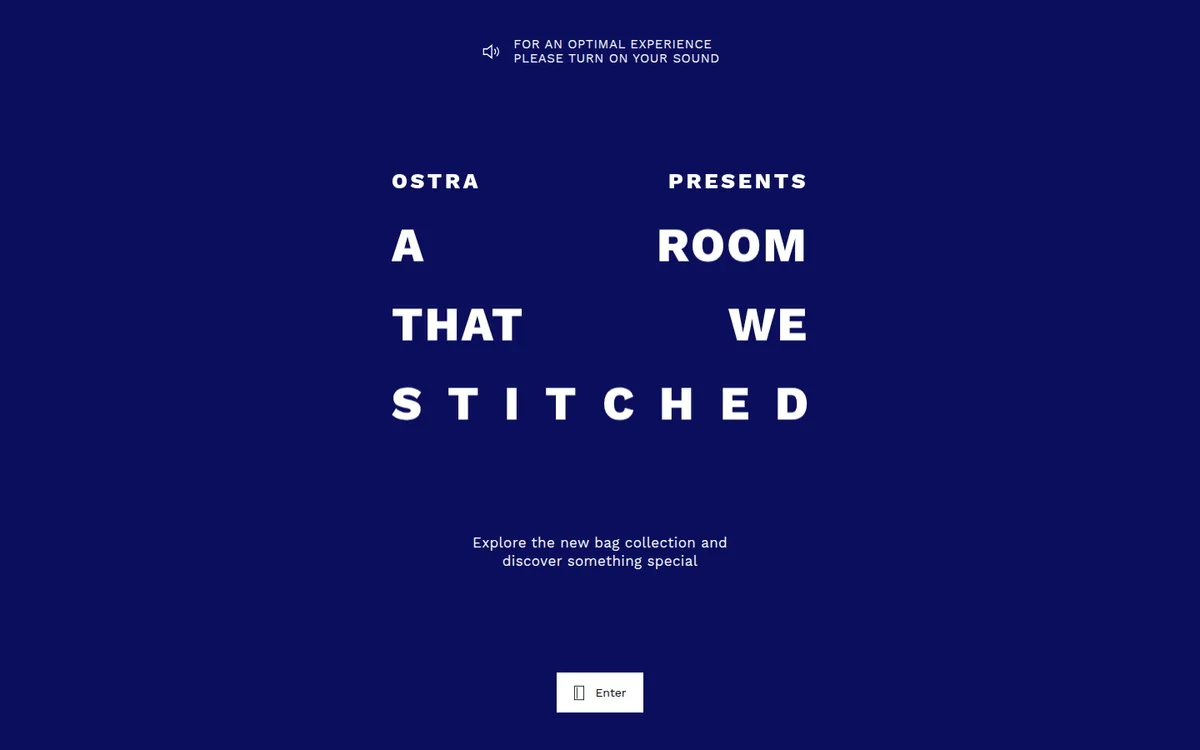
An immersive product launch staged as a walkable apartment. A deep-blue gate with a tracked, justified title leads into a single full-screen WebGL scene: a flat, symmetrical, retro-editorial photograph of a room. The cursor nudges it in parallax, the wheel dollies in, round hotspots on objects open the bags, and door hotspots push you through to the next room with a radial ripple. Yellow subtitles narrate each room. No scroll page at all.
Rebuild: design-inspiration-rebuilds/fashion/miu-miu-house (fictional content, generated images, open-source fonts; installed with the optional design-inspiration-rebuilds skill). Run it with npm install && npm run dev.
Design Tokens
| Role | Value |
|---|---|
| Gate blue | #0b0f5c |
| Subtitle yellow | #ffe100 |
| Tooltip / card cream | #fbf1e0 |
| Door red / green (in the imagery) | vermilion / grass green |
| Ink / white | #0a0a0a / #fff |
:root { --blue:#0b0f5c; --yellow:#ffe100; --cream:#fbf1e0;
  --ease: cubic-bezier(.23, 1, .32, 1); }   /* hotspot + panel curve, .6-.8s */
- Type: Work Sans (the original uses it too) at 800, uppercase, wide tracking for the gate title, laid out as justified two-word rows. A script face (original: Biro Script; substitute: Caveat) only inside the hint tooltip, like handwriting on a note. Sometype Mono for small labels.
- Colour: the UI is white, cream and one yellow; all saturation lives in the photography (painted doors, pastel walls), so the interface never competes with the product.
- Shape: hard square cards, circular hotspots with a pulsing ring, slight rotations (-1.5deg, 6deg) on notes and the sound toggle for a hand-placed feel. No shadows.
Motion Spec
| What | Trigger | Animation | Duration / easing | Rebuild file |
|---|---|---|---|---|
| Gate title | load | words slide up out of overflow-hidden rows, then sub/CTA fade in | .9s power4.out, stagger .05 |
src/intro.js |
| Gate exit | click Enter | gate wipes upward via clip-path: inset(0 0 100% 0) |
.9s power2.inOut |
src/intro.js |
| Room parallax | pointer | cursor offsets the texture UVs, lerped | lerp .06, ±.018 uv | src/room.js |
| Dolly zoom | wheel | zoom 1 → 1.35, eased | lerp .08 | src/room.js |
| Door transition | door click | radial reveal from the door, ripple at the band, old room zooms out through, new room settles | 1.6s power2.inOut |
src/room.js |
| Hotspots | room enter | pop in, pulsing ring; positions reprojected from image space every frame | .6s back.out(2), stagger .1 |
src/hotspots.js |
| Bag card | hotspot click | cream card slides in from the right (bottom sheet on mobile) | .8s cubic-bezier(.23,1,.32,1) |
src/style.css |
| Subtitles | room enter | letters appear one by one, hold, fade | .018 per char, hold 3.2s | src/subtitles.js |
| Film grain | always | hash noise added in the fragment shader | per frame | src/room.js |
Key excerpts
Door push-through transition: src/room.js
float r = uProg * 2.2;
float edge = smoothstep(r, r - .22, d);                 // 1 inside the reveal
vec2 dir = normalize(s - uOrigin + 1e-4);
vec2 sA = s + dir * edge * (1.0 - edge) * .16;          // ripple at the band
float zA = uZoom * 1.08 * mix(1.0, 1.5, uProg);         // old room rushes past
float zB = 1.08 * mix(1.3, 1.0, uProg);                 // new room settles
vec3 col = mix(a, b, edge);
Cover-fit with parallax: src/room.js
vec2 cover(vec2 s, float asp, float zoom, vec2 par){
  float r = uRes.x / uRes.y;
  vec2 k = r > asp ? vec2(1.0, asp / r) : vec2(r / asp, 1.0);
  return (s - .5) * k / zoom + .5 + par;
}
The 1.08 base zoom is overscan, so the .018 parallax never exposes an edge.
Hotspots that ride the image: src/room.js
// image-uv -> screen px, mirrors the shader
const z = u.uZoom.value * 1.08;
const tu = x - px, tv = (1 - y) - py;
const sx = (tu - .5) * z / kx + .5, sy = (tv - .5) * z / ky + .5;
return { x: sx * innerWidth, y: (1 - sy) * innerHeight };
Hotspots are plain DOM buttons (accessible, focusable) repositioned from the same maths as the shader.
Gate title reveal: src/intro.js
gsap.set(w, { yPercent: 110 });
gsap.timeline({ delay: .3 })
  .to(w, { yPercent: 0, duration: .9, ease: 'power4.out', stagger: .05 })
  .to(['.intro__sound', '.intro__sub', '.intro__enter'],
    { autoAlpha: 1, duration: .8, ease: 'power2.out', stagger: .12 }, '-=.4');
prefers-reduced-motion: parallax, dolly and the ripple transition are off; rooms cut instantly.
Why Award-Worthy
- One image, one shader, whole site. The experience is a single textured plane; parallax, zoom and transitions all come from UV maths, so it is light and consistent.
- Photography does the colouring. A neutral UI lets painted doors and pastel rooms carry the brand; yellow subtitles are the only recurring accent.
- Navigation as architecture. Doors are the menu; moving between rooms feels like walking, not clicking.
- Hotspots stay glued to objects because they are reprojected from image space, so the parallax never breaks the illusion.
- A confident gate. Justified tracked type on flat blue sets tone before any imagery loads.
Anti-patterns it avoids: no scrolling page of cards, no carousel, no heavy 3D models, no autoplaying video wall; the product is revealed by exploring.
Credits
- Original: immersivebags.miumiu.com by Merci Michel. Design and content are the intellectual property of their creators.
- Recognition: Awwwards Site of the Day, Developer Award.
- This study is an independent clean-room analysis. The rebuild uses a fictional house (Ostra), AI-generated images and open-source fonts; it contains no original code, assets, logos, products or copy.