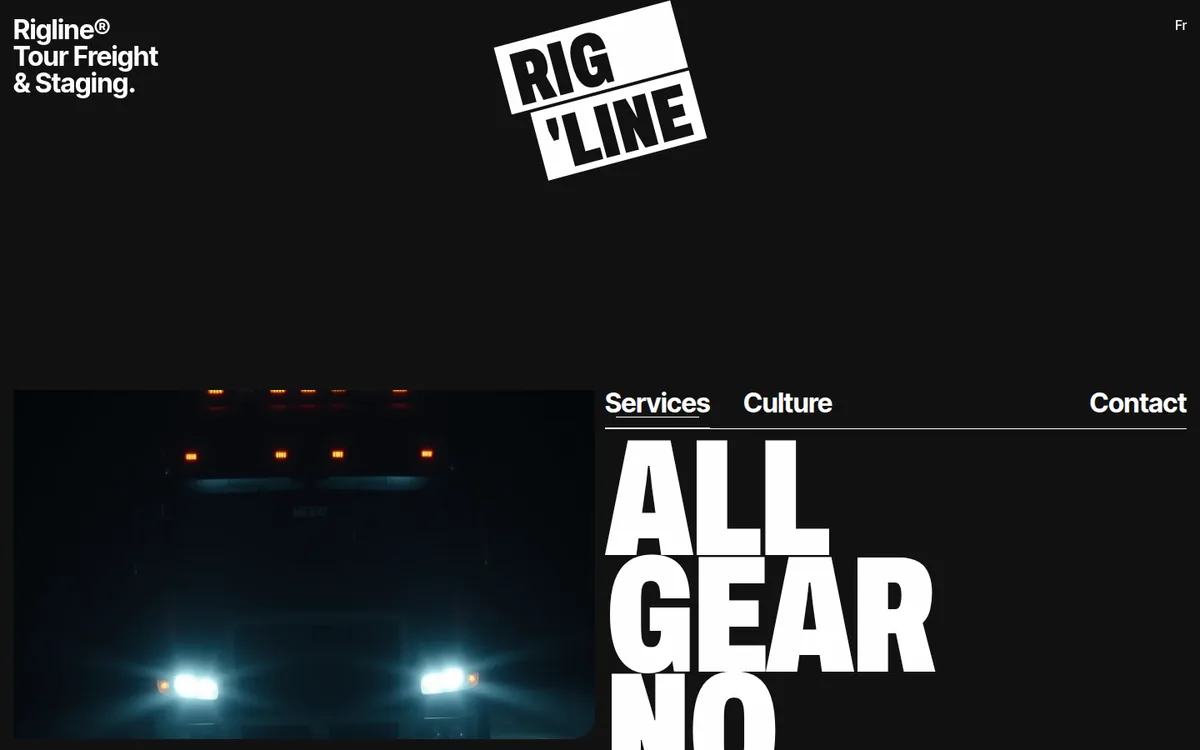
A logistics company for touring shows that sells itself like a band. Near-black page, one electric violet-blue, and a single idea: colossal condensed type that fills the viewport width, set against small, tight grotesk copy. A slanted stacked logo block is the only graphic mark.
Rebuild: design-inspiration-rebuilds/events/truck-n-roll (fictional content, generated images, open-source fonts; installed with the optional design-inspiration-rebuilds skill). Run it with npm install && npm run dev.
Design Tokens
| Role | Value |
|---|---|
| Ink (page, dark sections) | #121212 |
| Paper (type on dark, white section) | #fefefe |
| Violet-blue (CTA, footer) | #4a35ff |
| Ash (footer type) | #d3cecd |
:root {
  --ink: #121212; --paper: #fefefe; --blue: #4a35ff; --ash: #d3cecd;
  --ease: cubic-bezier(.76, 0, .24, 1);
  --pad: 16px;
}
- Type: two families. Body and UI in a neo-grotesk (original: Helvetica Now Display, 700, 32px
nav with
-0.32pxtracking; substitute Inter Tight). Display in an extra-condensed black (original: National 2 Condensed 900,200px / 140px,-4px; substitute Archivo atfont-stretch: 62%, 900). - Scale: small copy is 16px / 500 / 1.1; sub-heads 51px with
-1.53px; section statements are sized invw(about 19vw) so one word spans the screen. - Layout: two equal columns with a 12px gutter and a 16px page padding; hairline 1px rules separate every list. Images have a single squared corner with one large (28px) radius.
- Palette rule: three blocks of colour only: dark, one white interlude, one violet footer.
Motion Spec
| What | Trigger | Animation | Duration / easing | Rebuild file |
|---|---|---|---|---|
| Smooth scroll | always | Lenis { lerp: .1, smoothWheel, syncTouch }, driven by gsap.ticker, lagSmoothing(0) |
— | src/scroll.js |
| Load sequence | page load | logo blocks drop in rotated, headline lines rise from masks, nav fades | 1.1s back.out(1.6) / power4.out, stagger .09 |
src/intro.js |
| Image parallax + wipe | scroll | image yPercent -7 → 7 scrubbed; frame wipes open with clip-path inset |
scrub / 1.2s power3.inOut |
src/parallax.js |
| Huge headings | enters at 80% | masked line rise + scrubbed horizontal drift on alternating lines | 1.2s power4.out, stagger .1 |
src/huge.js |
| Sticky image swap | each step crosses 55% | sticky column; next image wipes up over the previous | .9s power3.inOut |
src/steps.js |
| FAQ accordion | click | height 0 ↔ auto, plus turns to minus; one open at a time | .55s power3.inOut |
src/accordion.js |
| Halftone statement | scroll through 330svh sticky stage | words are gridded "ASCII" texture, resolve to solid line by line while block lifts | scrubbed .6 | src/ascii.js |
| Use-case rail | scroll | section pinned, card row translates horizontally | scrub .5, linear | src/rail.js |
| Tilted marquee | always, scroll velocity | two crossing bands at ±3°, speed scales with scroll velocity | 28s linear loop | src/marquee.js |
Key excerpts
Smooth scroll on the GSAP ticker: src/scroll.js
const lenis = new Lenis({ lerp: 0.1, smoothWheel: true, syncTouch: true, touchMultiplier: 2, autoRaf: false });
lenis.on('scroll', ScrollTrigger.update);
gsap.ticker.add((t) => lenis.raf(t * 1000));   // gsap seconds -> lenis ms
gsap.ticker.lagSmoothing(0);
Masked headline lines: src/huge.js
gsap.from(lines, { yPercent: 105, duration: 1.2, ease: 'power4.out', stagger: 0.1,
  scrollTrigger: { trigger: h, start: 'top 80%', once: true } });
lines.forEach((l, i) => gsap.fromTo(l,
  { x: (i % 2 ? 1 : -1) * innerWidth * 0.03 },
  { x: (i % 2 ? -1 : 1) * innerWidth * 0.03, ease: 'none',
    scrollTrigger: { trigger: h, start: 'top bottom', end: 'bottom top', scrub: true } }));
Each .ln is overflow: hidden; the inner <i> slides, so the type seems to grow out of a floor.
Halftone type resolving to solid: src/ascii.js + src/style.css
.al { color: transparent;
  background: repeating-linear-gradient(0deg, #6a6a6a 0 1px, transparent 1px 3px),
              repeating-linear-gradient(90deg, #6a6a6a 0 1px, transparent 1px 3px);
  -webkit-background-clip: text; background-clip: text; }
.al::after { content: attr(data-t); position: absolute; inset: 0 0 auto; color: var(--paper); opacity: var(--s, 0); }
lines.forEach((l, i) => tl.to(l, { '--s': 1, duration: 0.14, ease: 'power1.inOut' }, 0.14 + i * 0.1));
A pure CSS texture, no canvas: a grid gradient clipped to the glyphs, with a solid copy faded in per line.
Sticky image swap: src/steps.js
ScrollTrigger.create({ trigger: el, start: 'top 55%', end: 'bottom 55%',
  onToggle: (self) => {
    if (!self.isActive) return;
    imgs.forEach((im, k) => {
      im.style.zIndex = k <= i ? k + 1 : 0;
      gsap.to(im, { clipPath: k <= i ? 'inset(0% 0 0 0)' : 'inset(100% 0 0 0)',
        duration: 0.9, ease: 'power3.inOut', overwrite: 'auto' });
    });
  } });
Velocity-driven marquee: src/marquee.js
gsap.fromTo(t, { xPercent: 0 }, { xPercent: -50, ease: 'none', duration: 28, repeat: -1 });
lenis.on('scroll', ({ velocity }) => { boost = Math.min(Math.abs(velocity) * 0.35, 6); });
gsap.ticker.add(() => { boost *= 0.92; tweens.forEach((tw) => tw.timeScale(1 + boost)); });
prefers-reduced-motion: Lenis is not created, reveals, parallax, pinning and marquee are skipped; the
halftone words render solid and the rail becomes a native horizontal scroller.
Why Award-Worthy
- Type is the image. Words sized to the viewport carry every section; photography is secondary and cropped hard.
- A disciplined palette. Black, one white interlude and a single violet footer give three clear chapters with no gradients.
- A texture made from type. The halftone statement turns a brand line into an event, with no heavy asset.
- Motion with one vocabulary. Masks and inset wipes everywhere: lines rise, images wipe open, images swap. Nothing fades generically.
- A footer with attitude. Tilted crossing bands reacting to scroll speed echo the slanted logo.
Anti-patterns it avoids: no carousels with arrows, no shadows or glass cards, no stock-icon grids; the FAQ is hairline rows, not boxes.
Credits
- Original: trucknroll.com by Locomotive. Design and content are the intellectual property of their creators.
- Recognition: Awwwards Site of the Day, Developer Award.
- This study is an independent clean-room analysis. The rebuild uses a fictional company, AI-generated images and open-source fonts; it contains no original code, assets or copy.