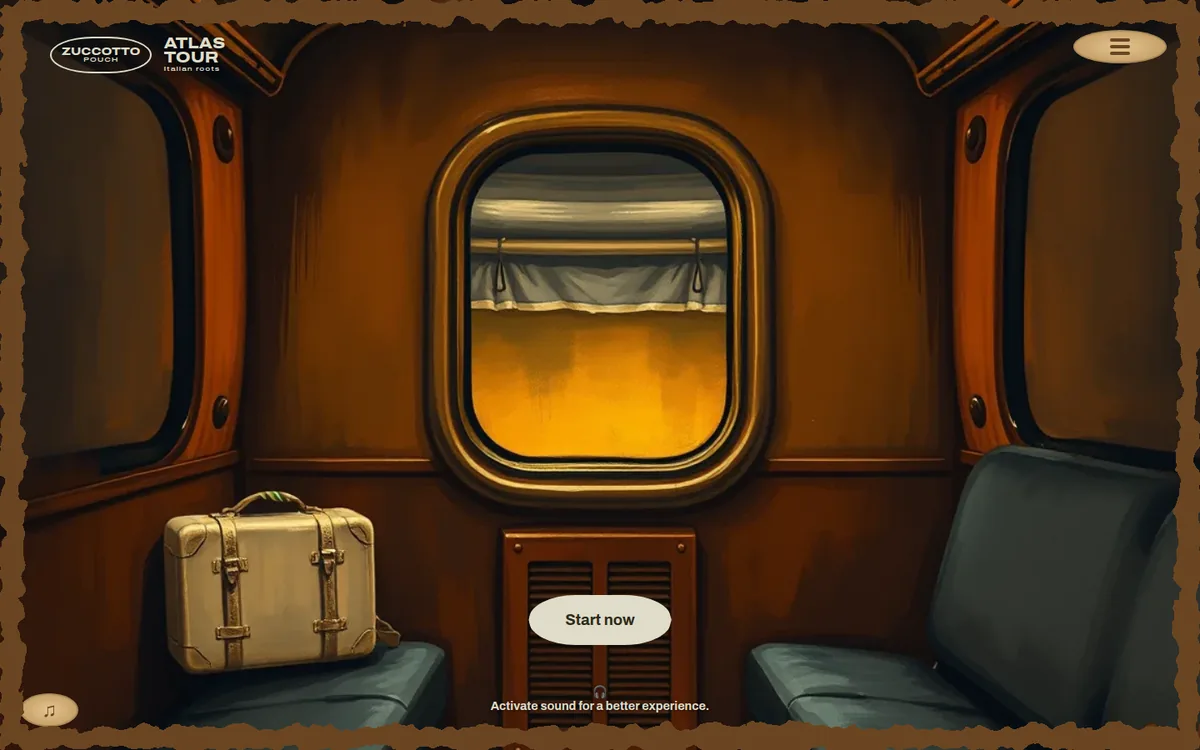
A brand campaign told as a painted journey: a small striped coin pouch travels from a train compartment through Italian rooms and landscapes. Every "page" is an oil-painted illustration with a rough brushed frame, the cursor tilts the scene, and scrolling dollies from one painting to the next. Interface chrome is warm paper, olive and brown, with extra-wide heavy type.
Rebuild: design-inspiration-rebuilds/art-illustration/pasticcino-world-tour (fictional content, generated images, open-source fonts; installed with the optional design-inspiration-rebuilds skill). Run it with npm install && npm run dev.
Design Tokens
| Role | Value |
|---|---|
| Frame / wood brown | #6b4423 |
| Ochre (scene fallback) | #c9a46a |
| Olive (cards, intro) | #46501a |
| Deep olive (type shadow) | #232a0e |
| Cream (type, buttons) | #dfdcc8 |
| Paper (cards) | #d8cba0 |
| Ink strip | #2c2a1a |
:root {
  --brown: #6b4423; --ochre: #c9a46a; --olive: #46501a; --olive-d: #232a0e;
  --cream: #dfdcc8; --paper: #d8cba0; --ink: #2c2a1a;
  --ease: cubic-bezier(.65, .05, 0, 1);   /* hover / button curve */
}
- Type: a wide heavy grotesk (original looks like an expanded grotesque; substitute: Archivo at
font-stretch: 125%, weight 800), uppercase, with a hard 4px offset shadow in deep olive. Kickers ("THE", "BEGINS", "CHAPTER 01") are small, bold, tracked.5em. - Frame: a fixed brown border run through an SVG
feTurbulence+feDisplacementMapfilter so it reads as a dry-brush edge. It sits above scenes and below overlays. - Shapes: buttons are scalloped pills (clip-path), the menu and sound buttons are wooden ovals,
cards are paper rotated about
-1.4degwith a dark pouch-pattern strip top and bottom.
Motion Spec
| What | Trigger | Animation | Duration / easing | Rebuild file |
|---|---|---|---|---|
| Smooth scroll | always | Lenis { lerp: .1 } on the GSAP ticker, lagSmoothing(0) |
— | src/scroll.js |
| Scene parallax | pointer move | oversized painting (inset -4%) moves opposite to the cursor, max about 3% of viewport | 1.2s power3.out (quickTo) |
src/parallax.js |
| Card tilt | pointer move | intro/paper cards rotate ±2.2deg and drift ±14px | .9s power3.out (quickTo) |
src/tilt.js |
| Gate sequence | click "Start now" | CTA fades, olive intro card wipes in, holds, gate wipes up | 1.1s power3.out, hold 2.2s, 1.2s power3.inOut |
src/gate.js |
| Scene journey | scroll (pinned, 100% per chapter) | next painting fades in while dollying scale 1.22 → 1; rail fill scrubs | scrub 1, linear | src/journey.js |
| Chapter title | chapter changes | ellipse clip-path wipe from the baseline + 35% y drift | .9s power2.inOut |
src/chapter.js |
| Hotspot → card | click | overlay fades, card drops from y 60 | .5s fade, .9s back.out(1.2) |
src/cards.js |
| Hotspot pulse | always | ring scales 1 → 1.9 and fades | 2s ease-out, loop | src/style.css |
| Menu | click | circular clip-path from the button, links rise | .8s power3.out; links back.out(1.2) stagger .07 |
src/menu.js |
| Hover states | hover | buttons lift and rotate -1.5deg | .75s cubic-bezier(.65,.05,0,1) |
src/style.css |
Key excerpts
Smooth scroll on the GSAP ticker: src/scroll.js
lenis = new Lenis({ lerp: 0.1, smoothWheel: true, autoRaf: false });
lenis.on('scroll', ScrollTrigger.update);
gsap.ticker.lagSmoothing(0);
gsap.ticker.add((t) => lenis.raf(t * 1000));   // gsap seconds -> lenis ms
Pinned painting crossfade with dolly: src/journey.js
const tl = gsap.timeline({ defaults: { ease: 'none' } });
scenes.forEach((s, i) => {
  if (i === 0) return;
  tl.fromTo(s, { opacity: 0, scale: 1.22 }, { opacity: 1, scale: 1, duration: 1 }, i - 1)
    .set(scenes[i - 1], { opacity: 0 }, i);
});
ScrollTrigger.create({
  animation: tl, trigger: stage, start: 'top top', end: `+=${steps * 100}%`,
  pin: true, scrub: 1,
  onUpdate: (self) => { /* rail fill + chapter index from self.progress */ },
});
Cursor parallax on the paintings: src/parallax.js
const setters = bgs.map((b) => [gsap.quickTo(b, 'x', { duration: 1.2, ease: 'power3.out' }),
  gsap.quickTo(b, 'y', { duration: 1.2, ease: 'power3.out' })]);
addEventListener('pointermove', (e) => {
  const nx = e.clientX / innerWidth - 0.5, ny = e.clientY / innerHeight - 0.5;
  setters.forEach(([sx, sy]) => { sx(-nx * innerWidth * 0.032); sy(-ny * innerHeight * 0.032); });
});
Brushed frame: src/style.css
.frame { position: fixed; inset: 0; z-index: 30; pointer-events: none;
  border: clamp(10px, 1.4vw, 22px) solid var(--brown); filter: url(#rough); }
/* <feTurbulence baseFrequency=".035" numOctaves="3"/> + <feDisplacementMap scale="26"/> */
Menu circle from the button: src/menu.js
gsap.fromTo(menu, { clipPath: `circle(0px at ${origin()})` },
  { clipPath: `circle(150vmax at ${origin()})`, duration: 0.8, ease: 'power3.out' });
gsap.fromTo(list.children, { yPercent: 110, rotate: 4 },
  { yPercent: 0, rotate: 0, duration: 0.9, ease: 'back.out(1.2)', stagger: 0.07, delay: 0.25 });
prefers-reduced-motion: smooth scroll, parallax, tilt and pulse are off; transitions shortened to
near zero. Content stays reachable via the menu.
Why Award-Worthy
- Illustration is the interface. Every screen is a full-bleed painting; UI is reduced to a few tactile objects (wooden buttons, paper cards), so the brand story is never a layer on top.
- A tangible frame. A single displaced border gives the whole site a hand-made edge without any per-screen decoration.
- Depth from flat art. Oversized paintings, cursor parallax and a scrubbed dolly make 2D images feel like rooms you walk through.
- Restricted palette. Brown, ochre, olive, cream: the type and cards inherit the paintings' colours.
- Chaptered pacing. One wheel gesture advances one painting; the numbered chapter title and rail always show where you are, and hotspots reward exploration with small notes.
Anti-patterns it avoids: no glassmorphism or gradients on UI, no generic fade-up reveals, no scroll hijack without a visible progress indicator, no mixed illustration styles.
Credits
- Original: Pasticcino Bag World Tour 2026 by MONOGRID. Design and content are the intellectual property of their creators.
- Recognition: Awwwards Site of the Day.
- This study is an independent clean-room analysis. The rebuild uses a fictional brand, AI-generated
images (listed in
images.json) and open-source fonts; it contains no original code, assets or copy.